Technical Guide | Can HDPE Pipes with Different SDRs Be Butt Fused?
- Share
- publisher
- RUBR
- Issue Time
- Oct 3,2026
Summary
Can HDPE pipes with different SDRs be butt fused? In some cases, yes—but the same outside diameter is not enough. This article explains how wall thickness affects the joint and what to confirm before welding, including material compatibility, project requirements, and a written fusion procedure.
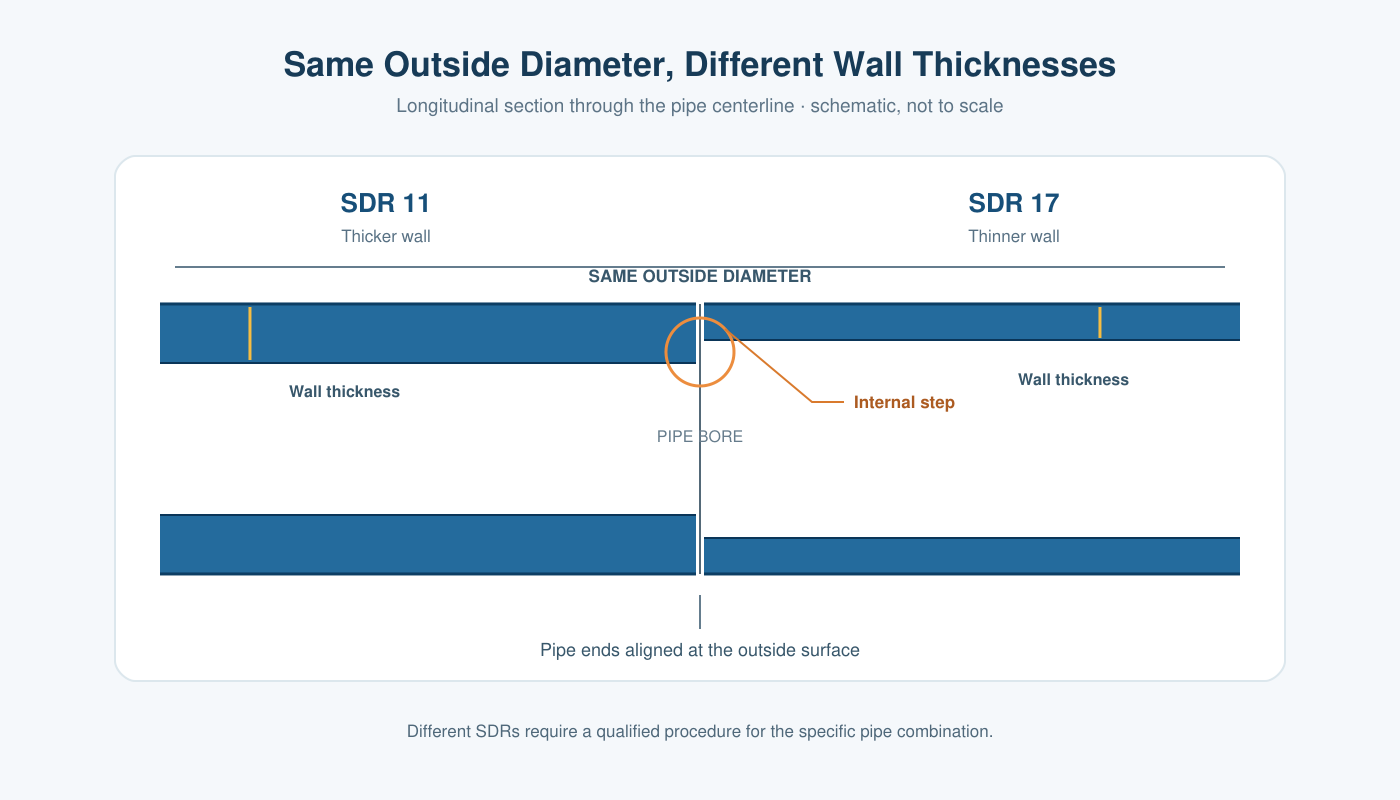
Yes, under certain conditions. Two HDPE pipes can have the same outside diameter but different wall thicknesses if their SDRs differ. They should not be joined by simply applying the standard procedure for pipes of equal wall thickness.
The Plastics Pipe Institute (PPI) states that PE pipes with the same outside diameter and different wall thicknesses may be butt fused under special conditions. Such joints have limitations, so PPI advises consulting the pipe manufacturer and obtaining written recommendations for the specific application.
What changes when the SDRs are different?
SDR is the ratio of a pipe’s outside diameter to its nominal wall thickness. At the same outside diameter, a lower SDR means a thicker wall.
For example, consider two pipes with an outside diameter of 315 mm:
| Pipe | Approximate wall thickness (OD ÷ SDR) | Relative wall thickness |
| 315 mm SDR 11 | 28.6 mm | Thicker |
| 315 mm SDR 17 | 18.5 mm | Thinner |
These calculated values illustrate the difference. Check the applicable pipe specification, markings, and actual dimensions before joining.
When the outside surfaces are aligned for butt fusion, the inside diameters do not match. This leaves a step on the inside of the joint. The fact that both pipes fit in the machine and their ends meet does not, by itself, establish that a standard fusion procedure is suitable.
Why shouldn’t you use standard parameters without checking?
A procedure for two pipes of equal wall thickness may not be suitable for a joint between a thicker and a thinner pipe. The required heating, fusion force, and cooling conditions need to be established for the particular combination. The appearance of the finished bead alone cannot confirm that the procedure was appropriate.
The pipe materials and the project requirements also matter. PPI treats butt fusion between different wall thicknesses as a special case and recommends obtaining written joining instructions from the pipe manufacturer for the components and installation involved.
What should be checked before butt fusion?
| Check | Confirm |
| Pipe dimensions | The actual outside diameter and wall thickness of both pipes |
| Pipe materials | The material grades, manufacturers, and relevant product information |
| Project requirements | Whether the specified connection is permitted and meets the pipeline’s design requirements |
Fusion procedure | Whether a written procedure covers this particular combination, including parameters and acceptance criteria |
A procedure used for a similar SDR combination on another project should not automatically be applied to these pipes.
What should the site team do?
Identify and measure both pipes, then check the project drawings and specifications. Provide the pipe details to the pipe manufacturer or the project’s responsible engineer and confirm whether direct butt fusion is permitted. If it is, follow the approved written procedure and its inspection requirements.
If a suitable direct butt fusion procedure cannot be established, ask the project designer and relevant suppliers to specify an appropriate transition connection. Its dimensions and pressure rating must also be checked.
Conclusion
Different SDRs do not automatically rule out butt fusion, but matching outside diameters do not automatically permit it. Confirm the pipe materials, project requirements, and a suitable written fusion procedure before making the joint.